
If you feel you need to use walking poles for rehabilitation or help with your walking, there are a few things you may need to consider
What is the primary reason you feel you might benefit from using poles? – this could affect the type of poles you select and how you use them
- For many, this might be due to dizziness, balance issues or a general feeling of being less stable when walking.
- For others there might be a specific physical condition or area of pain such as knees, hips or the lower back when walking.
- General weakness, posture and confidence can also be factors to consider.
- Finally, consider whether or not the condition or issue is likely to improve or needs to be managed.
These are all questions that our experts would ask when consulting with somebody about walking poles for rehabilitation*. Their advice would then include, the type of pole, the height adjustment plus the basic movement patterns advised (both initially as a the walker progresses)
*See below for specific rehabilitation and Stability walking pole models (which are vat exempt)and how they help.
One pole or two?
In 90% of cases, the advice would be to use TWO poles with the only exception being if there are issues with movement, grip etc on one particular side of the body
The reason we advise using two poles is the improvement it makes to posture, core engagement and spinal rotation. Using a pole to one side often results in a twist of the upper body , uneven weight distribution through one wrist and poor posture.
Improvement in posture will also help to improve balance as the eyes are looking forward rather than downwards – a common factor in those who are losing confidence with walking. Another benefit is that it opens the chest and aids breathing.
We encounter quite a bit of resistance when we advise two poles and this is understandable as people feel they would impede on the use of the hands when out and about. We understand that and help to counter that by advising walkers to walk with two poles at least 3 times a week to maintain good posture and gait but if they prefer, use a single pole when performing tasks such as shopping. We also advise on detachable wrist straps (see below) to enable them to free up hands whenever required.
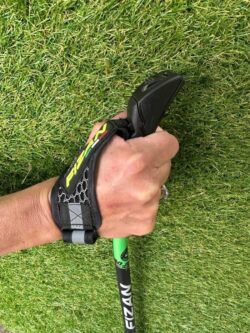
Traditional Nordic walking straps
Handles and straps
What we do NOT advise is that anyone with a greater risk of falling is attached to their poles via a traditional NORDIC WALKING strap which will not break away. These look like gloves and clip into the pole handles ( as shown in the image)
As demonstrated in the image, these straps may also result in over gripping which can compromise the wrist angle and be uncomfortable for those with arthritis etc.
When you feel unstable, it is tempting to grip pole handles tightly but this affects both your posture and gait. It can also create tension in the upper body, discomfort in the hands and is not great for those with hypertension either. Avoid any poles with a thin handle (hiking or trekking poles) and look for specific poles with the following features:-
- A wider base on the handle which will encourage a soft grip
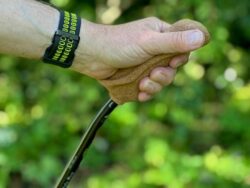
An angled pole with soft grip handle
A design that supports the thumb and enables whole hand engagement on the handle where pressure is put through the palm and Thenar area (base of thumb)and not the side edge of the little finger or outer edge (heel of the hand – unless you need extra stability – see below)
- Handle is set on an angled pole shaft to ensure a neutral wrist position when the user grips the handle lightly
- If you need ultimate support and weight bearing, seek poles with a supportive hand guard that breaks away – see image below
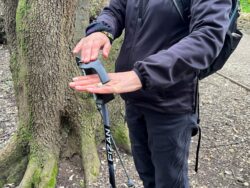
The secret to using poles correctly is to achieve stability and confidence whilst walking as naturally as you can manage and these factors will help enormously.
Rubber ferrules – which type?
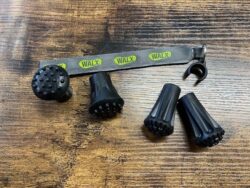
Surprisingly, these are also important. If you need to walk on hard surfaces, you can choose how much stability the rubber bases (or paws as we call them) provide you. Our experts will always advise based on how much weight is put through the poles and also if the walker needs to pause for balance or due to freezing etc. Wider stability ‘paws’ have a larger surface and tend to benefit those who need greater support with the poles in a more upright position whereas the all terrain ‘paws’ are designed to encourage more core engagement as they provide less stability. If this can be achieved, it is beneficial and will help with posture and fitness.
Adjusting for your height
It is essential that poles are adjusted to the right height for you and the reason you are using them. If poles are too low they can cause a stoop or lean, impede gait and put pressure on the wrists. If they are too long, they do not allow a normal arm swing and can also affect wrist comfort. Good poles will have been tested to withstand downward pressure and will clearly indicate this – cheaper trekking poles can have weak adjusters which could ‘slip’ when weight bearing and could also be made of inferior alloys. Look for aircraft quality alloys and twist lock or clip lock adjusters which have been tested. Avoid poles with the pop button adjustment that fits into a hole ( often seen on crutches) If the alloy is not aircraft quality these can wear around the hole and cause weakness in the pole shaft. They also restrict height adjustment to the set heights which is not always appropriate.
Need further help or advice?
At WALX we have specialised in the use and development of walking and Nordic walking poles since 2004 and have backgrounds in exercise referral and physical therapy. We hold wellness walks all over the UK and provide pole walking clinics from our HQ HUB in Dorset.
We also have a network of professional and insured Instructors and Physios who can help you use poles correctly plus extensive video help guides.
The team have developed a process that matches the mobility, gait and balance of a walker with the correct motion and poles. The aim is to also provide progression where possible rather than see poles as purely an aid for stability.
Our patented WALX poles are used in hospitals such as the Royal National Orthopaedic Hospital and for specific training and projects for Parkinson’s UK. Client testimonials for Multiple Sclerosis, Fibromyalgia, ME and many other conditions They were designed in the UK as result of extensive research and an understanding of ALL pole types and makes. All materials are of high quality (aircraft quality alloys) and fabricated is in Italy by experienced pole manufacturers – we strive to ensure our carbon footprint is as low as possible so do not ship from the far East.
For more information about using poles for rehabilitation click HERE
For professionals seeking to provide support and advice on using poles – find out about becoming a WALX partner HERE