
By Gill Stewart at

Recently, it has been impossible to open a newspaper or watch the news without a mention of how good walking is for you. Thats great of course but it can also be a tad confusing when each article cites research that is quoting different recommendations about the daily steps or miles per hour you need to do.
 The research usually relates to specific health benefits too – cardiovascular health, warding off dementia, managing diabetes and preventing falls etc
At WALX we believe that it is not just the quantity of the steps or miles you do but the quality and we feel its much easier to make changes that work for you if you are less stressed about recording how many you do but make the most out of what you are able to manage.
Walking is undoubtedly a rewarding and valuable way to be more active and the studies all point to valid reasons that you should do as much as you can but do you really need to do 10,000 steps a day?
A recent study cited that a single continual walk of 15 minutes a day was better that a few short walks and that would equate to circa 1,500 steps for most people. Another study which was in relation to lowering the risk of cancer and cardiovascular disease determined that 2,000 steps a day were effective.
So what about the 10,000 steps a day which is a figure still crops up regularly but has never been one we feel is likely to get more people out walking? It was loosely based on boosting sales for an early Japanese pedometer around the time of the Tokyo Olympics rather than any specific studies – although some have of course been conducted since.
In fact a study published in the Lancet compared 15 of these daily step count studies and found that whilst 8 – 10,000 steps a day is a good level for those in mid life, the benefits taper off for the over 60’s with circa 6,000- 8,000 being more appropriate.
The main reason, daily step counts of over 5,000 are not something we tend to promote at WALX is we know people can be put off by the time it would take to fit this into busy lives. We like to promote achievable goals where possible and base our advice on the NHS guidelines for physical activity and the types of exercise you need to include in an average week ( 150 minutes of moderate physical activity for Adults plus 2 strength sessions per week – see below)
 In fact we prefer to add everything you need into a walking session and concentrate more on smiling than counting or measuring!
In a typical WALX Total body walking session we would be aiming at circa 3,000 steps of steady state walking (a moderate pace but always dependent on the fitness levels of the group)BUT we would also be adding bursts of brisker pace which leads us onto more studies about the benefits of walking!
It is important to mix the pace of your walks either by doing some short but faster ones and some longer but less intensive ones OR to add some bursts of speed into the longer walk. This helps you to avoid the plateau that can come with walking at the same pace every day and it means you can gain similar benefits to doing H.I.I.T (High intensity Interval training) circuits.
The main reason we advise this is at WALX is that studies like this one in the British Medical journal show that those who were fit enough to walk BRISKLY (100 or more steps per minute) could reduce the risk of morbidity! Furthermore the University of Leicester published a study in 2022 that proved there was a link between brisk walking and DNA that also reflected directly on the likelihood of living longer.
If thats not enough reason to pick up the pace once in a while perhaps this report by Harvard health in 2017 which found that walking briskly for 20 minutes a day could reduce the risk of heart disease by up to 30 per cent and this article about how brisker walking helps ward off dementia is proof enough!
That all makes sense so why do WALX Instructors also add balance exercises and even make you walk backwards sometimes?
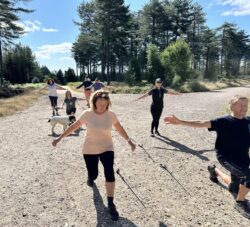 It’s all about making sure that your body is challenged and ready for anything! Walking backwards may seem daft but it targets the muscles in a different way and can really help with posture and muscle balance. Some studies also show that it increases the calories burned by up to 10 per cent – so there is method in our madness!
As we age, balance can deteriorate quickly too so it makes sense to include some exercises that help and are easy to do when out walking. Simply walking along a white line or pausing with your foot in mid air before placing it down can make a huge difference. Our Instructors are trained to add these plus others drills that improve strength or make you work harder than you might do if walking on your own.
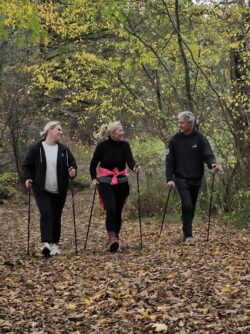 Obviously another way to increase the effectiveness of your daily steps is to use two poles as this will help you walk further and faster as well as boost calorie consumption and reduce the strain on hips and knees.
So lets all start thinking about the quality of the steps we take rather than the quality and make sure we mix up the speed, add some drills, use poles and even add a hop or skip now then which is vital for our bone health and should also be done daily as outlined in this article by the Royal Osteoporosis Society.
Above all, walking at any speed is one of the best ways to connect with nature and boost your mental health so try thinking about how many quality steps you can fit into your week and your body will be glad you did!
WALX Total body walking sessions are available all over the UK – to get started go along for a FREE DISCOVERY session or to learn how to master poles for whole body benefits try a Power of poles session.