By Gill Stewart at

As a leading walking for fitness brand, we view PACE as an important factor when it comes to walking for results. However, it may surprise you to know that we do not always advise on a faster pace.
Thats because, a good workout and wellness plan will always include a mix of paces and here’s why!
 Brisk or Fast Pace
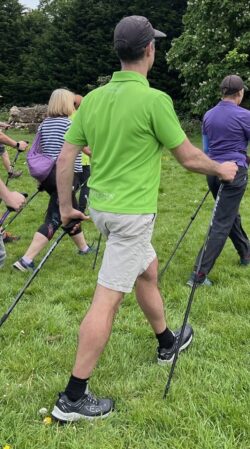
Walking briskly is known to have huge benefits including links to changes in DNA that reduce the risk of dementia*.It is hard to determine brisk as it is different for each walker but typically it is measured by either steps per minute or miles per hour.
We are not advocates of measuring yourself against others so in reality your brisk pace is when you can only talk in short bursts weaker than form a sentence but if you like a physical benchmark, its circa 100 steps per minute for an average adult. Miles per hour is also subjective but the NHS guidelines indicate that brisk pace for an average adult is 3 – 3.5 miles an hour.
Some people are natural fast walkers and others may need to work on this by doing short bursts of faster walking. In fact the latter can increase effectiveness – see below. Those using 2 poles can often manage a brisker pace because poles provide forward propulsion by harnessing the power of the upper body (despite feeling easier, the added use of upper body muscles also increases cardiovascular output)
The main thing to remember about walking briskly is that if you do the same thing every day, whilst good for you, is not as effective as mixing it up as you will see below.
In WALX sessions, the Instructors use pace to increase the workout effect on their wellness and fitness walks. Using interval training principles, helps participants to work harder and keep progressing rather than attending a regular blast with poles which no longer pushes them to improve.
Before we explore this principle, let’s look at walking slowly which also has huge benefits and should not be ignored.
 The Power of slow
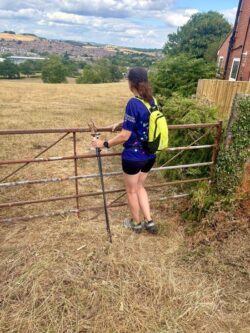
Walking slowly between bursts of speed allows the body to recover and a good instructor will alter the length of the slow and fast elements in order to improve fitness, aid weight loss and boost heart health.
However, slower paced walking is also a great way to work on HOW you walk or HOW YOU USE POLES! Take time to walk slowly, thinking about posture, how your plant your feet and how you swing your arms. Notice how your chin is level with the ground and your core is engaged. Try speeding up and many of these elements are lost as you pump the arms, lean forward and often lose the comfortable stride and full foot roll.
When walkers walk fast with poles, it can affect their poling technique – it often results in short arm swings and poles almost stabbing the ground – see this article. Take time to slowly explore how each part of the body should be working when walking with poles and you will find that you feel it more in both the legs and arms than if you just blast along. It’s no different to any other workout – if somebody lifts weights slowly and precisely it far outweighs the fast snatched methods others may employ – the latter does not target the muscles fully.
Train yourself to notice at which speed your poling technique tends to drop and aim to walk well at a pace that is working the whole body the hardest. Ask your Instructor to help with this too.
Walking slowly also has a host of other benefits worth exploring…
 Connecting with nature
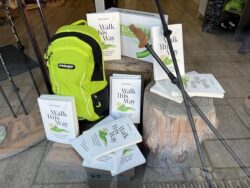
If you are constantly walking at pace, you will miss out on the wonder of nature. Slow down and look deeply at what is around you, notice the beauty and daily changes. Look at what moves ( in flight or via the wind/waves) and bring in your other senses like smell and sound. There’s nothing as grounding as taking time to breathe in the fresh air as you notice the smell of leaves, fresh rain or the sea. Listening to the sounds and even taking time to touch the foliage or tree bark you encounter can be more powerful than you think.
Slowing your walking and linking it to your breathing can help you to clear your mind and just be in the moment. Try taking 4 steps as you breathe in and fours as you breathe out. Next focus on your feet as they connect with the ground and connect with nature using the methods above. The rhythmic action of walking (especially with poles) has a meditative effect and is proven to aid mental wellbeing. It is also known to boost creativity and clarity of thought so practice being in the moment and enjoying the motoring of walking slowly but well.
* study by Leicester university – for more information on all the methods and facts in this article – see WALK THIS WAY published by Bloomsbury Press and full of ideas that will give you Russian to walk and results from doing so!