
By Gill Stewart at

Non pole walkers often comment that using poles just means having to carry something extra!
Those who use poles correctly know that that’s not the case and using two poles can massively improve your comfort and performance BUT in some cases it is easy to lapse into simply going through the motions and not actually benefitting from your poles. It’s good practice to check your technique every now and then to ensure no bad habits or complacency has crept in!
We notice this can be an issue with experienced Nordic walkers, especially when in a group. (Most Instructors will tell you how their groups increase the effort if they think the Instructor is close!)
One of the key elements to check is how the poles are planted into the ground and whether the walker is actually gaining any power from them.
Here we explore how bad habits can creep in and how to address them to maximise your pole plant
SPEED
Often it is when people have gained fitness and are walking faster that pole use can suffer. As they speed up the walkers can reduce the shoulder swing in order to facilitate faster arm movements and this has two major effects.
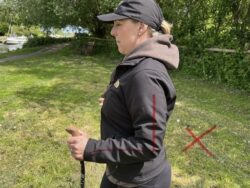
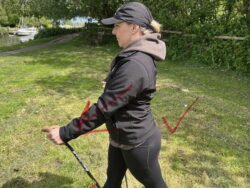
1. Not swinging the arm from the shoulders can create a bent arm action with most of the effort coming from the biceps which reduces the power gained from the major upper body muscles – this action tends to also mean the pole is not angled correctly and is therefore less likely to provide as much forward propulsion
2. Tapping and not Pushing – Fast furious poling can result in the pole plant being a quick tap on the ground rather than a commitment to push. We often help those who complain of vibration in their poles with drills to work on this fault. Somehow, they have evolved in a faster and HARDER pole plant which is simply not necessary and if the pole is not at the right angle (as mentioned above) wastes a lot of energy too
CONTACT WITH THE GROUND
This is related to the above actions but VERY important. It is not just how hard or fast you plant the pole but how long it remains in contact with the ground. A quick tap of a pole does not give you enough time to harness the full power or to actually push yourself forwards
A pole plant needs to be firm but not harsh and the tip needs to stay in contact with the ground rather than be snatched away.
In essence you are walking on all fours so try to think about matching the pole plant to the footstrike and making it last the same amount of time rather than be a quick tap.
PRACTICE DRILL
One great tip we use when teaching people how to use total body walking poles is the 123 foot roll and plant drill
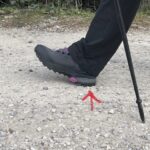
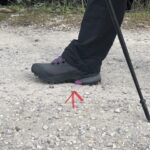
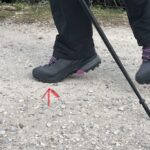
Think of your foot plant as having 3 phases as you stride forwards – 1. heel strike- 2. roll through the sole – 3. push off the toes. Consciously count 123 as each foot has this contact with the ground and most importantly….. make sure the pole tip also remains on the ground for the same count as you use it to propel yourself forward. This longer more controlled push through the pole will increase your upper body engagement and power far more than a short but hard stabbing action
POLE PLANT CHECKS
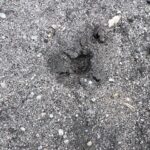
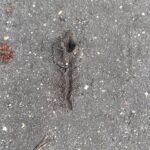 1. A great way to check that you are gaining maximum contact with the ground is to check that your pole tip leaves a ‘clean’ hole in soft ground – there should be no evidence of the tip dragging or scuffing – simply a round hole where the tip has been
If you are using rubber paws on hard surfaces – the giveaway may be the wear on the paw. It should be even with no evidence of scuffing or excessive wear on one side.
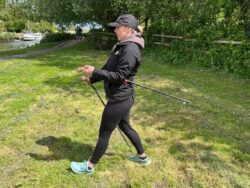 2. Check for pole vibration. If you fall into the trap of banging a pole into the ground with a short sharp tap – the poles will tend to vibrate and even rattle more. This is also likely to damage or weaken the adjustment mechanism and can cause injury to your wrists/thumb joints too. A great analogy is to think of a hammer tapping a nail into a piece of wood – in that instance you need short sharp taps to drive the nail in – you simply would not be able to drive it in via one long push – BUT when you are trying to push yourself forward with the poles, it is the opposite. You are not using your energy to drive the pole into the ground, you are using it to push yourself forward. Better for the poles and better for you too!
3. The One arm drill (shown above) is a great way to slow down and check the foot action on one side of the body and pole action on the other. Pop one pole under your arm and slowly stride and push with the other one. By only using one you can concentrate on both the correct arm action, the longer push and 123 foot roll!
Take some time to practice all of the the elements above and you will notice that your pole walking will be more EFFECTIVE and far more COMFORTABLE too.